


The concept of "Holy War" in individual religious traditions

Christianity
Further information: Christianity and violence, Ecclesia militans, Miles Christianus, New Testament military metaphors and Military saint
Further information: Military order (society), Crusades, European wars of religion and Thirty Years' War
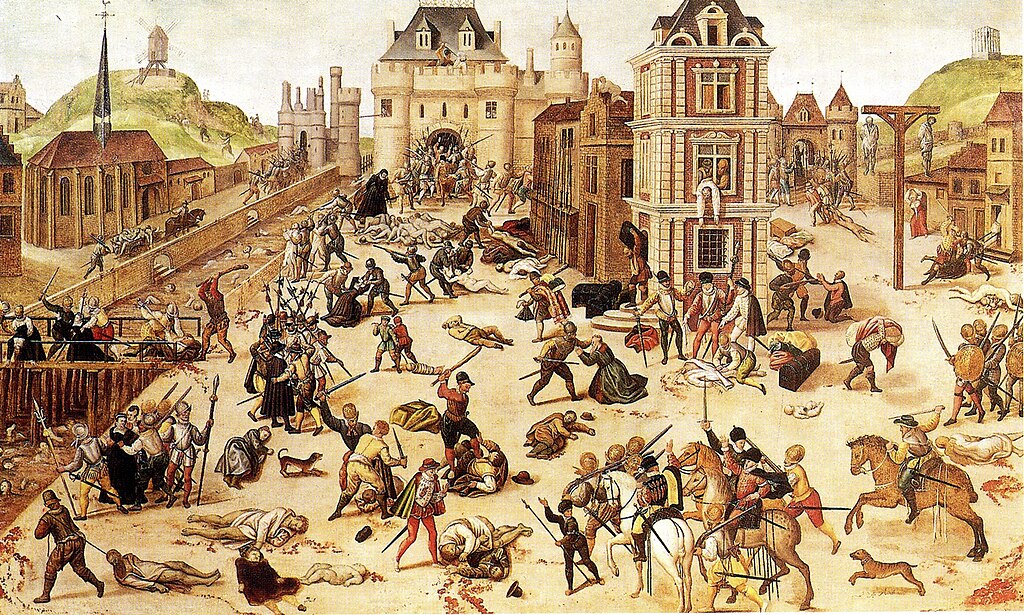
Those who fought in the name of God were recognized as the Milites Christi, warriors or knights of Christ. The Crusadeswere a series of military campaigns that took place during the 11th through 13th centuries against the Muslim Conquests. Originally, the goal was to recapture Jerusalem and the Holy Land from the Muslims, and support the besieged ChristianByzantine Empire against the Muslim Seljuq expansion into Asia Minor and Europe proper. Later, Crusades were launched against other targets, either for religious reasons, such as the Albigensian Crusade, the Northern Crusades, or because of political conflict, such as the Aragonese Crusade. In 1095, at the Council of Clermont, Pope Urban II raised the level of war from bellum iustum ("just war"), to bellum sacrum ("holy war").[17] In 16th Century France there was a succession of wars between Roman Catholics and Protestants (Hugenots primarily), known as the French Wars of Religion. In the first half of the 17th century, the German states, Scandinavia (Sweden, primarily) and Poland were beset by religious warfare in theThirty Years War. Roman Catholicism and Protestantism figured in the opposing sides of this conflict, though CatholicFrance did take the side of the Protestants but purely for political reasons.
The Battle of Las Navas de Tolosa, known in Arab history as the Battle of Al-Uqab (معركة العقاب), took place on 16 July 1212 and was an important turning point in theReconquista and in the medieval history of Spain.[18] The forces of King Alfonso VIII of Castile were joined by the armies of his Christian rivals, Sancho VII of Navarre, Pedro II of Aragon and Afonso II of Portugal in battle[19] against the Berber Muslim Almohad rulers of the southern half of the Iberian Peninsula.
Islam
Main article: Muslim conquests
Further information: Islam and war, Jihad and Jihadism
Further information: Muslim conquest of Persia, Islamic conquest of Afghanistan, Muslim conquest in the Indian subcontinent, Muslim conquest of Egypt, Muslim conquest of the Maghreb, Umayyad conquest of Hispania, Islamic invasion of Gaul, Muslim conquest of Sudan, Byzantine–Ottoman Wars and Ottoman wars in Europe
There were also a number of periods of infighting among Muslims; these are known by the term Fitna and mostly concern the early period of Islam, from the 7th to 11th centuries, i.e. before the collapse of the Caliphate and the emergence of the various later Islamic empires.The Muslim conquests were a military expansion on an unprecedented scale, beginning in the lifetime of Muhammad and spanning the centuries, down to the Ottoman wars in Europe. Until the 13th century, the Muslim conquests were those of a more or less coherent empire, the Caliphate, but after the Mongol invasions, expansion continued on all fronts (other than Iberia which was lost in the Reconquista) for another half millennium until the final collapse of the Mughal Empire in the east and the Ottoman Empire in the west with the onset of the modern period.
While technically, the millennium of Muslim conquests could be classified as "religious war", the applicability of the term has been questioned. The reason is that the very notion of a "religious war" as opposed to a "secular war" is the result of the Western concept of the separation of Church and State. No such division has ever existed in the Islamic world, and consequently there cannot be a real division between wars that are "religious" from such that are "non-religious". Islam does not have any normative tradition of pacifism, and warfare has been integral part of Islamic history both for the defense and the spread of the faith since the time of Muhammad. This was formalised in the juristic definition of war in Islam, which continues to hold normative power in contemporary Islam, inextricably linking political and religious justification of war. This normative concept is known as Jihad, an Arabic word with the meaning "to strive; to struggle" (viz. "in the way of God"), which includes the aspect of struggle "by the sword", Jihad is sometimes understood as Holy War, and jihads have been called to convert other non-Muslim states to Islam or as defense.
The first forms of military Jihad occurred after the migration (hijra) of Muhammad and his small group of followers to Medina from Mecca and the conversion of several inhabitants of the city to Islam. The first revelation concerning the struggle against the Meccans was surah 22, verses 39-40:
This happened many times throughout history, beginning with Muhammad's battles against the polytheist Arabs including the Battle of Badr (624), and battles inUhud (625), Khandaq (627), Mecca (630) and Hunayn (630).

The medieval Iberian Peninsula was the scene of almost constant warfare between Muslims and Christians. Periodic raiding expeditions were sent from Al-Andalus to ravage the Christian Iberian kingdoms, bringing back treasure and slaves. In raid against Lisbon, in 1189, for example, the Almohad caliph Yaqub al-Mansur took 3,000 female and child captives, while his governor of Córdoba, in a subsequent attack upon Silves in 1191, took 3,000 Christian slaves.
The Almohad Dynasty conquered all Northern Africa as far as Libya, together with Al-Andalus (Moorish Iberian Peninsula). The Almohads, who declared an everlasting Jihad against the Christians, and they treated the dhimmis harshly.[25] Faced with the choice of either death or conversion, many Jews and Christians emigrated. Some, such as the family of Maimonides, fled east to more tolerant Muslim lands,[26] while others went northward to settle in the growing Christian kingdoms.
In the late tenth century, a story spread that before Muhammad destroyed the idols at the Kaaba, that of Manāt was secretly sent to a Hindu temple in India; and the place was renamed as So-Manāt or Somnath. Acting on this, the Shiva idol at theSomnath temple was destroyed in a raid by Mahmud Ghazni in CE 1024; which is considered the first act of Jihad in India.[30] In 1527, Babur ordered a Jihad against Rajputs at the battle of Khanwa. Publicly addressing his men, he declared the forthcoming battle a Jihad. His soldiers were facing a non-Muslim army for the first time ever. This, he said, was their chance to become either a Ghazi (soldier of Islam) or a Shaheed (Martyr of Islam). The Mughal emperor Aurangzeb waged a Jihad against those identified as heterodox within India's Islamic community, such as Shi'a Muslims.[31][32]
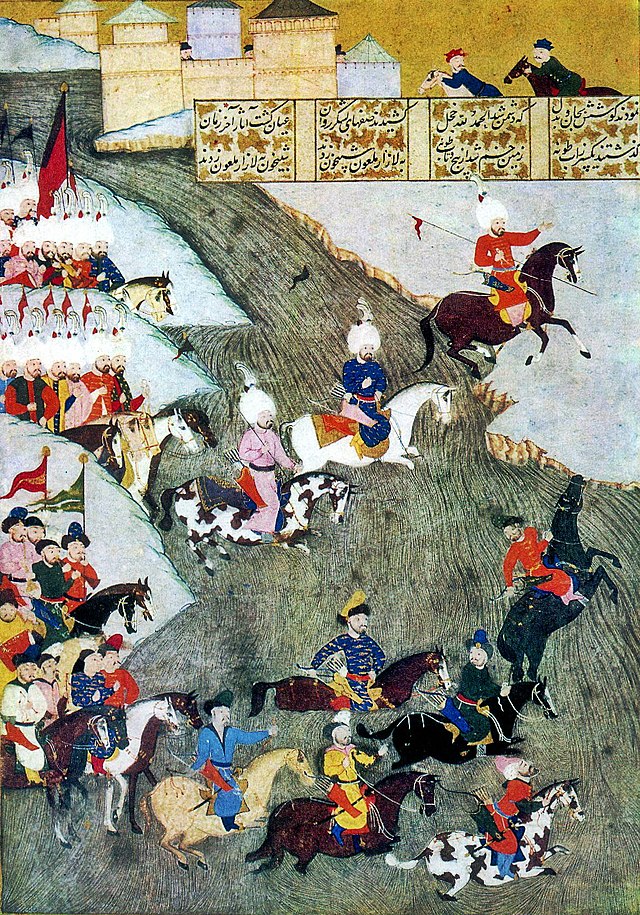
Upon succeeding his father to rule the Ottoman Empire, Suleiman the Magnificent began a series of military conquests in Europe.[33] On 29 August 1526, he defeated Louis II of Hungary (1516–26) at the battle of Mohács. In its wake, Hungarian resistance collapsed and the Ottoman Empire became the preeminent power in Central and Eastern Europe.[34] In July 1683 Sultan Mehmet IV proclaimed a Jihad and the Turkish grand vizier, Kara Mustafa Pasha, laid siege to Vienna with an army of 138,000 men.
On 14 November 1914, in Constantinople, capital of the Ottoman Empire, the religious leader Sheikh-ul-Islam declares Jihad on behalf of the Ottoman government, urging Muslims all over the world—including those in the Allied countries—to take up arms against Britain, Russia, France, Serbia and Montenegro in World War I. On the other hand, Sheikh Hussein ibn Ali, the Emir of Mecca, refused to accommodate Ottoman requests that he endorse this jihad, a requirement that was necessary were a jihad to become popular, on the grounds that "the Holy War was doctrinally incompatible with an aggressive war, and absurd with a Christian ally: Germany"
Judaism
Main article: Milkhemet Mitzvah
| “ | From the earliest days of Israel's existence as a people, holy war was a sacred institution, undertaken as a cultic act of a religious community. | ” |
In the Jewish religion, the expression Milkhemet Mitzvah (Hebrew: מלחמת מצווה, "commandment war") refers to a war that is both obligatory for all Jews (men and women) and limited to territory within the borders of the land of Israel. The geographical limits of Israel and conflicts with surrounding nations are detailed in theTanakh, the Hebrew Bible, especially in Numbers 34:1-15 and Ezekiel 47:13-20.
0 التعليقات:
إرسال تعليق